Mobirise Website Builder

Image Description

What Are 1 to 1 Classes

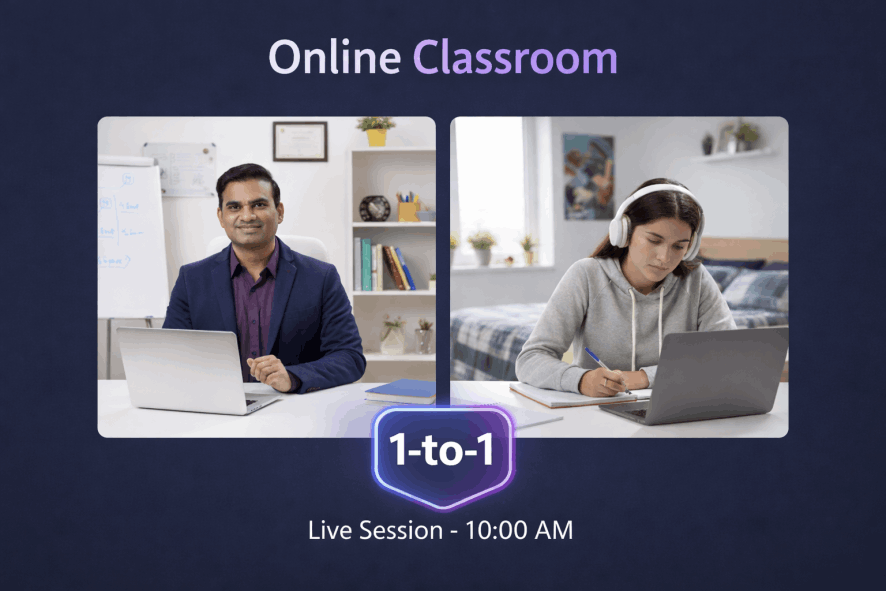
1-to-1 classes are a personalized learning format where one teacher teaches one student at a time. This allows focused teaching, better understanding, and a learning pace tailored specifically to the student.

Mobirise Website Builder
Why 1-to-1 Classes?

IIn the current scenario, the teacher–student ratio in most coaching institutes is around 1:100, and in some large batches it can even reach 1:500. In such crowded classrooms, even capable and hardworking students often do not receive the attention they need.

As a result, doubts remain unresolved, concepts are compromised, and the pace of teaching rarely matches the student’s pace of understanding. This gap significantly affects learning outcomes and reduces the chances of success in competitive exams like JEE Main, JEE Advanced, or NEET.

1-to-1 classes eliminate these limitations by ensuring focused teaching, effective interaction, and learning at the student’s own pace.

Benefits of 1-to-1 Classes

Student gets tailored solution to his/her requirements as per the current level. Speed can be increased/decreased as per the requirements. Homework and study material can be modified as per the need of student. Student gets personal attention, feedback, tests etc. everything required for the overall development of the subject knowledge.

Mobirise Website Builder

Study Material Used in 1-to-1 Classes

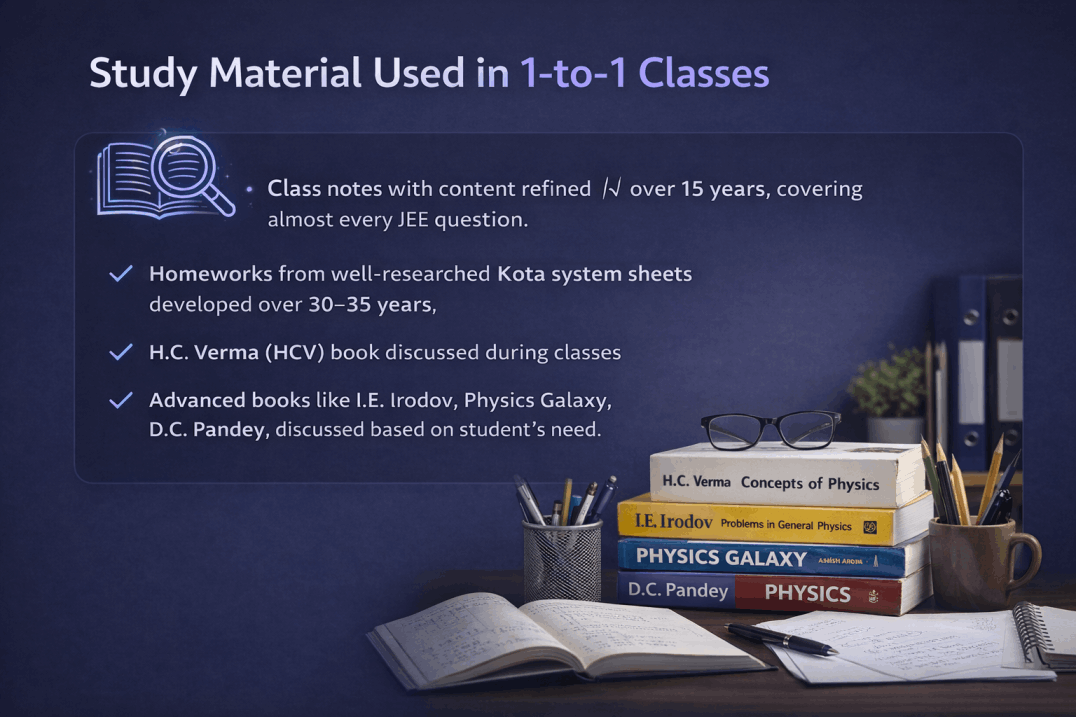
The class notes are well-researched and content-rich, developed and refined over the last 15 years. Almost every question asked in JEE is covered through these class notes.

Homework is assigned from well-researched Kota system sheets developed over the last 30–35 years. In addition, the H.C. Verma (HCV) book is discussed during classes. Based on the student’s response and requirement, advanced books such as I.E. Irodov, Physics Galaxy, D.C. Pandey, etc., are also discussed.

Test Frequency

One test is conducted immediately after the completion of each chapter. The test discussion is done during the class itself. In addition, periodic part-syllabus tests and full-syllabus tests are conducted to ensure proper understanding and reinforcement of concepts.

Daily Practice Problems (DPPs)

Based on the student’s response during the class, Daily Practice Problems (DPPs) are provided. Each DPP consists of 10–20 questions from mixed topics (till taught).

This approach ensures that the previously taught topics remain fresh in the student’s mind and the subject stays continuously revised.

A Signature Creation — Designed by Vidit